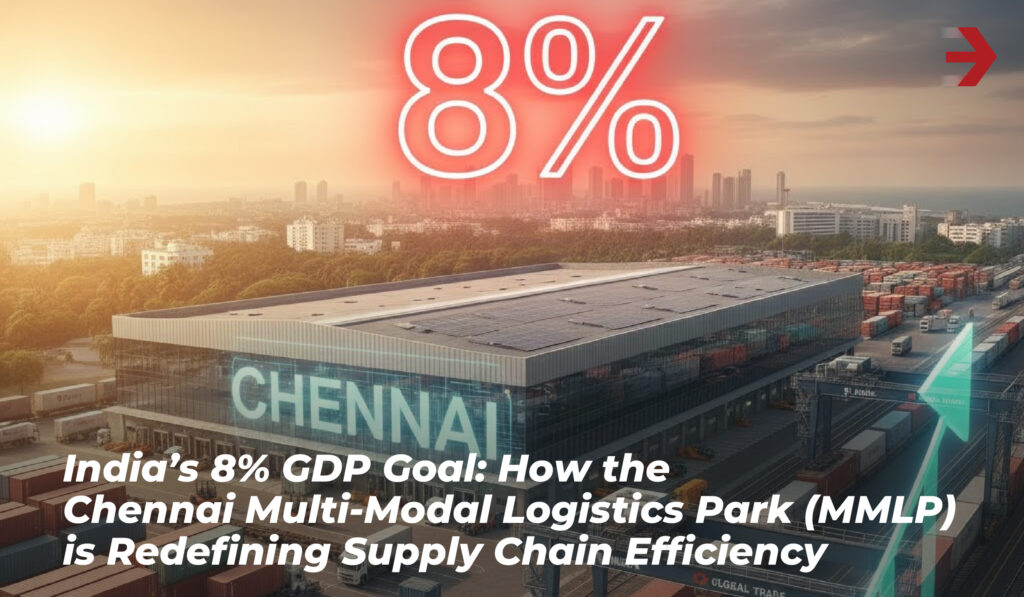
India’s push to bring logistics costs down to globally competitive levels is no longer just a policy ambition—it’s becoming measurable performance. A recent Government of India logistics-cost assessment places India’s total logistics cost at 7.97% of GDP (FY 2023–24), indicating major progress versus the historically cited higher cost base. DigiFootprint+1
One of the most practical on-ground enablers of this shift is the rise of Multi-Modal Logistics Parks (MMLPs)—large, integrated nodes that combine road + rail + warehousing + value-added logistics services into a single, efficiency-first ecosystem. In South India, the Chennai MMLP at Mappedu (Tiruvallur district) is positioned to become a pivotal backbone for EXIM and domestic distribution by integrating connectivity, consolidation, and modern logistics infrastructure. Press Information Bureau+2ETInfra.com+2
This blog breaks down what’s changing, why Chennai is central to the shift, and how manufacturers, exporters, importers, and e-commerce sellers can directly benefit.
India’s 8% Logistics-Cost Goal and Why It Matters to Shippers
“Logistics cost” isn’t just transportation spend. It’s the sum of costs created by delays, fragmentation, inventory buffers, warehousing inefficiencies, empty miles, re-handling, paperwork friction, and unpredictable lead times. India’s National Logistics Policy framework and allied infrastructure programs aim to cut friction across the system so goods move faster, more reliably, and at lower total cost. Invest India+1
The latest official assessment showing logistics cost at 7.97% of GDP reinforces the momentum—especially important for:
- Export competitiveness (pricing and delivery commitments)
- MSME growth (lower logistics overhead improves margins)
- Supply chain resilience (less “buffer inventory” required)
- On-time performance across ports, airports, ICDs/CFS, and inland movement DigiFootprint+1
What Exactly Is the Chennai MMLP (Mappedu)?
The Chennai MMLP is designed as a world-class aggregation and distribution node that integrates multiple logistics functions in one place—reducing re-handling, cutting dwell times, and lowering “hidden” supply chain costs.
Key project indicators and intent (as publicly shared by government and project documents) include:
- Location: Mappedu, Tiruvallur district, near Chennai
- Designed to be a southern logistics focal point with strong connectivity to ports/air cargo corridors
- Planned features include warehousing, cold storage, and value-added services like packaging/labelling, with road and rail connectivity Press Information Bureau+1
- Phase 1 includes components such as warehouses, common utilities, CFS, and gate complex Environment Clearance
Recent project updates have also indicated Phase 1 readiness targets around early 2026 (as reported via port-linked statements and industry coverage). Maritime Gateway+1
Why Chennai’s MMLP Can Be a Step-Change for Supply Chain Efficiency
1) Consolidation reduces cost per shipment
When freight is fragmented, each small movement pays a “penalty”—in vehicle underutilization, multiple pickups, and longer scheduling windows. An MMLP makes it easier to:
- Consolidate LTL into FTL
- Combine LCL loads more efficiently
- Stage cargo for vessel/flight cut-offs with less buffer time
2) Faster EXIM flow through better staging and documentation readiness
Exporters frequently lose time not at sea or in the air—but before the shipment even leaves, due to documentation gaps, late stuffing, congestion, and cut-off misses. With integrated facilities (like a CFS function in the plan), shippers can reduce:
- Last-minute rework
- Cargo rolling to the next vessel/flight
- Storage and detention exposure Environment Clearance+1
3) Better cold-chain and high-value cargo handling
South India’s fast-growing categories—pharma, electronics, specialty chemicals, and perishables—require infrastructure discipline. MMLP planning includes cold storage and value-added services, improving quality, integrity and reducing spoilage/claims. Press Information Bureau+1
4) Stronger links to manufacturing clusters
The Chennai region’s broader industrial belt supports:
- Automotive components and finished vehicles
- Electronics and industrial equipment
- Textile exports (including nearby clusters)
An MMLP acts like a pressure-release valve—absorbing freight at scale and distributing it through a structured node rather than chaotic point-to-point movement.
What This Means in Real Numbers (Operational Impact)
Even without quoting company-specific savings, the mechanisms that typically drive measurable gains in integrated logistics nodes are well understood:
- Lower dwell time → fewer demurrage/storage events
- Fewer touches → reduced damage and claims
- Higher asset utilization → lower cost per ton/km
- Reduced inventory buffers → working capital improves
- Predictable cut-offs → stronger OTIF performance
At the macro level, India’s measured logistics cost reduction supports the direction of travel. DigiFootprint+1
How Businesses Can Use Chennai MMLP to Improve Their Supply Chain
If you’re an exporter (Chennai/South India → UAE / Asia / USA)
- Use the MMLP as a staging and consolidation hub
- Reduce missed sailings by aligning stuffing + documentation earlier
- Build an “export rhythm” (weekly cycles) instead of last-minute dispatch
If you’re an importer (UAE/China/HK/USA → Chennai)
- Use bonded/structured staging to control landed-cost variability
- Improve inbound predictability for production planning
- Reduce emergency air shipments caused by late inbound flow
If you’re in pharma or electronics
- Prioritize controlled handling and storage discipline
- Build SOPs around temperature integrity, labeling, and scan-based traceability
- Reduce insurance exposure with better process control
Where Clematis Logistics Fits Into This Shift
Infrastructure creates the opportunity. Execution creates the result.
A modern logistics partner helps you translate MMLP advantages into:
- mode-mix optimization (air/sea/road)
- consolidation planning
- customs-ready documentation discipline
- warehousing + distribution flow design
- time-critical options when timelines are non-negotiable
This is where end-to-end freight forwarding + compliance + warehousing capability becomes a competitive advantage—not a commodity.
Conclusion: Chennai’s MMLP Is More Than a Project—It’s a New Operating Model
India’s logistics cost trajectory—now officially assessed at 7.97% of GDP (FY 2023–24)—signals that structural improvements are taking hold. DigiFootprint+1
For South India, the Chennai (Mappedu) MMLP is poised to accelerate this shift by combining connectivity, consolidation, cold-chain readiness, and logistics services into one integrated node. Press Information Bureau+2Environment Clearance+2
For shippers, the takeaway is simple: the next wave of competitiveness will come from how intelligently you design flows around these new nodes—not just which carrier you book.