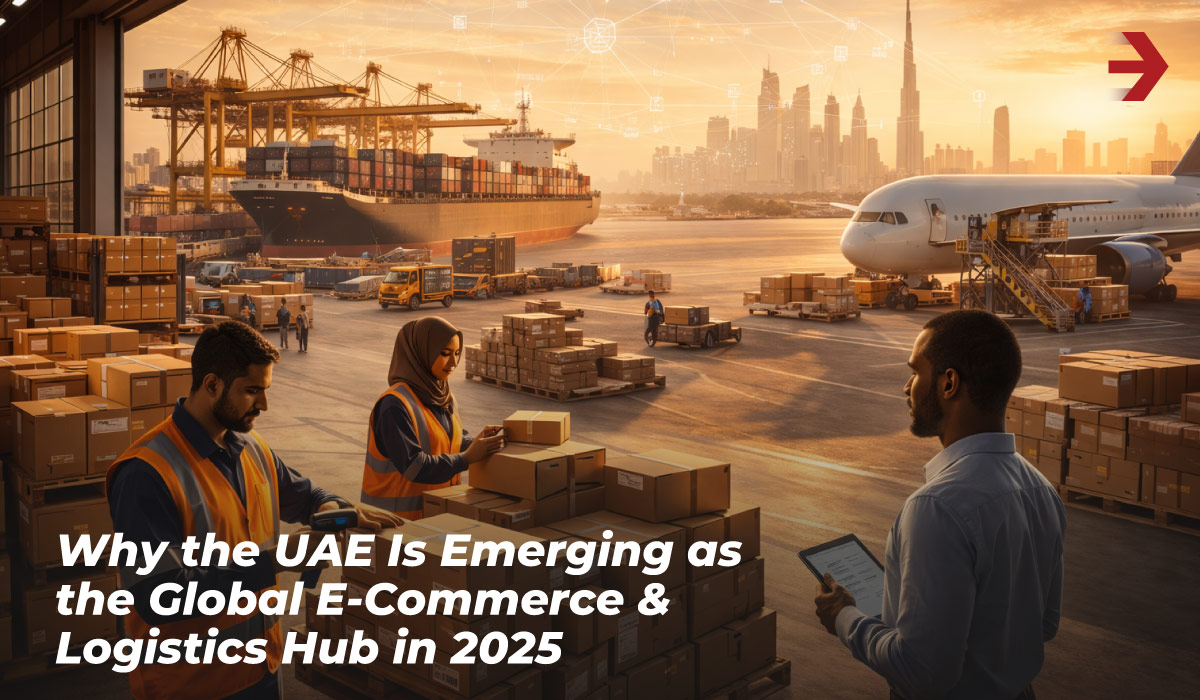
The UAE has rapidly consolidated its position as a global e-commerce and logistics powerhouse. Rapid digital adoption, future-fit infrastructure (ports, free zones, airports), progressive customs and trade digitalization, world-class free zones (JAFZA, DAFZA, DMCC), and a growing roster of 3PL & technology partners have combined to create one of the most attractive regional hubs for cross-border commerce in 2025. This is visible in rising e-commerce market size, significant trade growth through Jebel Ali and other free zones, and bold public-private investments in blockchain, AI and digital trade platforms.
1. A fast-growing e-commerce market — consumer demand + cross-border flows
The UAE’s e-commerce market has expanded rapidly over recent years. Independent market analyses estimate the UAE e-commerce market at several billion USD and project strong CAGR into the second half of the decade as digital payments, mobile penetration, and consumer adoption rise across retail, electronics and grocery verticals. This domestic growth increases demand for logistics services and positions the UAE as an attractive regional fulfillment hub for retailers targeting the Gulf and wider MENA region.
2. World-class gateway infrastructure: ports, airports and free zones
The UAE’s logistics advantage starts with infrastructure. Jebel Ali (DP World / JAFZA) remains a flagship global trade gateway with deep-water port capacity and purpose built logistics parks for warehousing and value-added services. JAFZA’s sustained growth in trade volumes and its ecosystem of thousands of companies make it a first-stop for exporters and 3PLs setting up regional distribution. Similarly, Dubai’s airports and strategically located free zones (DAFZA, DMCC, Dubai South) offer bonded facilities, fast licensing and proximity to air cargo lanes — ideal for e-commerce fulfilment and transit operations. DP World+1
3. Digital customs & trade platforms — removing friction
A critical enabler is the UAE’s active push to digitize customs and trade processes. Dubai Customs and other UAE authorities have rolled out blockchain pilots and cross-border e-commerce platforms to speed clearance, reduce paperwork, and increase trust among trading partners. These digital tools lower cost and uncertainty for cross-border e-commerce and encourage international sellers to position inventory and operations in the UAE for faster regional delivery. Government of Dubai Media Office+1
4. Pro-business policies and free-zone advantages
Free zones provide tax and ownership incentives, bonded storage, and simplified customs procedures that are particularly compelling for international sellers and 3PLs. Dubai’s Economic Agenda (D33) and other strategic plans also prioritize trade growth and digital transformation, explicitly linking economic policy with logistics and e-commerce expansion. The result: international brands and startups find it easier and faster to establish regional operations in the UAE.
5. Private sector investment & technology ecosystem
Large private operators and global tech firms are investing significantly in the UAE. DP World and other logistics players have expanded park & warehousing footprints, while major cloud and AI firms (e.g., Alibaba Cloud) are adding data center and digital infrastructure capacity in Dubai — unlocking advanced data, AI and real-time logistics capabilities that modern e-commerce needs (forecasting, last-mile orchestration, dynamic pricing). Those investments accelerate the UAE’s attractiveness as a logistics command center.
6. 3PL, fulfillment & last-mile readiness
The UAE market has seen rapid growth of 3PLs, fulfillment centers, and last-mile networks offering same-day or next-day delivery across urban centers. Fulfillment nodes in Dubai and Free Zone warehouses enable e-commerce merchants to hold regional inventory, reduce cross-border transit times, and improve customer experience — a critical differentiator for online retailers competing on delivery speed and returns management. Industry reports on UAE e-commerce logistics show the increasing role of fulfillment providers and returns handling in the market’s scalability.
7. Strategic location & global connectivity
The UAE’s geographic location between Asia, Europe and Africa — combined with robust air and sea schedules — makes it unrivaled for re-exports and regional distribution. Many companies use Dubai as a consolidation hub to serve GCC markets and to re-ship to Africa and parts of Europe, reducing transit times and improving service reliability for global e-commerce merchants and exporters. Recent logistics indices also place the UAE highly among emerging market logistics hubs in 2025.
8. Why this matters to merchants, brands and 3PLs
- Faster delivery windows: Holding regional stock in UAE warehouse networks allows merchants to offer shorter delivery times to GCC customers.
- Lower landed costs: Bonded storage, consolidated shipments, and simplified duty treatment reduce cost per order.
- Regulatory ease: Free zone structures and digital customs reduce administrative friction.
- Tech leverage: Edge data centers and local cloud capacity make advanced fulfillment tech (AI routing, dynamic slotting) viable with lower latency.
9. Challenges & what to watch
The UAE’s rapid rise is not without operational pressure: peak-season capacity, urban last-mile congestion, and the need for skilled logistics labor remain constraints. Sustainability and green logistics (EV fleets, energy usage in warehouses) are growing priorities that operators must address to align with global ESG expectations. Finally, competition from other regional hubs will remain intense; continued investment in digitization, talent and cross-border policy harmonization will be essential. (See recent market outlooks and logistics market forecasts.)
10. The bottom line
By combining consumer e-commerce growth, world-class infrastructure, digital trade platforms, pro-business free zones, and major private and tech investments, the UAE in 2025 presents a uniquely powerful platform for global e-commerce and regional logistics. For retailers and exporters seeking fast, reliable regional reach into the GCC, MENA and parts of Africa and Europe, the UAE is increasingly the operational choice — and the investments to date suggest this trend will continue.